Introduction
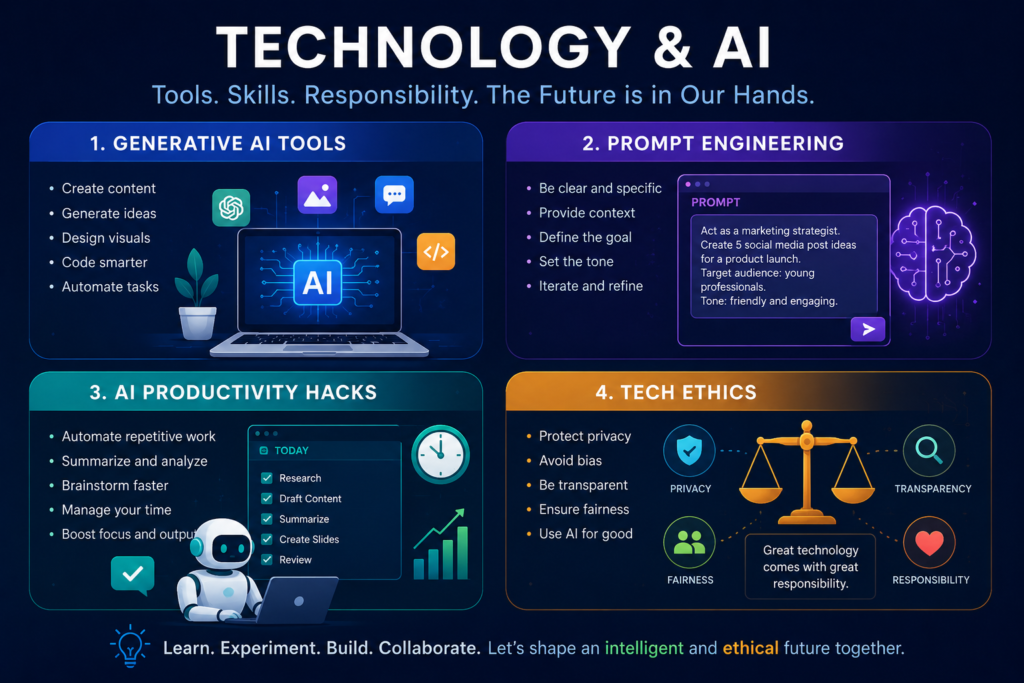
The world of Technology & AI is evolving at an unprecedented pace. Businesses, students, content creators, and professionals are increasingly relying on generative AI tools to automate tasks, enhance creativity, and improve productivity. At the same time, understanding prompt engineering, applying AI productivity hacks, and addressing tech ethics have become essential skills in the digital age.
This comprehensive guide explores how these four pillars are shaping the future of technology and transforming the way we work and interact with artificial intelligence.
What Is Generative AI?
Generative AI refers to artificial intelligence systems capable of creating new content such as text, images, videos, music, and computer code. Unlike traditional AI, which mainly analyzes data and makes predictions, generative AI produces original outputs based on user instructions.
Popular examples include AI chatbots, image generators, coding assistants, and video creation platforms.
The rapid growth of generative AI tools has revolutionized industries by helping businesses create content faster, automate repetitive tasks, and improve decision-making processes. From marketing campaigns to software development, generative AI is becoming a valuable resource for organizations worldwide.
Why Generative AI Matters
Generative AI provides several benefits:
- Accelerates content creation.
- Reduces manual workloads.
- Enhances creativity and innovation.
- Improves business efficiency.
- Supports personalized customer experiences.
As Technology & AI continue to advance, generative AI tools are expected to become even more powerful and integrated into everyday workflows.
Top Generative AI Tools Transforming Industries
Generative AI tools are helping professionals across various industries achieve better results in less time.
AI Writing Tools
AI writing assistants can generate blog posts, product descriptions, marketing content, social media captions, and email campaigns. These tools help writers overcome creative blocks while improving efficiency.
Benefits
- Faster content production.
- Improved SEO optimization.
- Consistent brand messaging.
- Enhanced content quality.
AI Image Generation Tools
Image-generation platforms allow users to create stunning visuals using simple text prompts. Designers, marketers, and entrepreneurs use these tools to create graphics, advertisements, and social media content.
Benefits
- Reduced design costs.
- Faster visual content creation.
- Increased creative possibilities.
AI Coding Assistants
Software developers use AI coding assistants to generate code, identify bugs, write documentation, and streamline software development processes.
Benefits
- Faster coding.
- Improved accuracy.
- Enhanced productivity.
- Better code quality.
AI Video and Audio Tools
Video and audio AI platforms help creators produce professional multimedia content without extensive technical expertise.
Benefits
- Automated editing.
- Voice generation.
- Video enhancement.
- Content localization.
These innovations demonstrate how generative AI tools are driving the next wave of technological transformation.
Prompt Engineering: The Key to Better AI Results
One of the most important skills in Technology & AI is prompt engineering.
Prompt engineering is the practice of designing clear and effective instructions that guide AI systems toward producing high-quality outputs.
The quality of AI-generated content largely depends on the quality of the prompts users provide.
Why Prompt Engineering Is Important
Many users assume AI automatically understands their intentions. However, vague instructions often produce generic or inaccurate responses.
Effective prompt engineering helps users:
- Obtain more accurate results.
- Reduce AI misunderstandings.
- Generate detailed content.
- Improve workflow efficiency.
- Save valuable time.
Essential Prompt Engineering Techniques
Be Specific
Specific prompts generate more useful responses.
Instead of:
“Write about AI.”
Use:
“Write a 1,500-word article explaining how generative AI tools improve workplace productivity for small businesses.”
Specificity provides context and direction.
Assign a Role
Role-based prompts often improve response quality.
Examples:
- Act as a digital marketing expert.
- Act as a software engineer.
- Act as an SEO consultant.
This technique helps AI tailor responses to specific audiences and industries.
Provide Context
The more context AI receives, the better it can understand user expectations.
Helpful context may include:
- Target audience.
- Desired tone.
- Purpose of content.
- Length requirements.
Request Structured Output
Users can ask AI to generate:
- Lists.
- Tables.
- Step-by-step guides.
- Outlines.
- Reports.
Structured outputs are often easier to read and implement.
Prompt engineering is becoming one of the most valuable skills in the modern Technology & AI landscape.
AI Productivity Hacks for Maximum Efficiency
AI productivity hacks help individuals and businesses achieve more in less time.
When used strategically, AI can significantly improve daily workflows and eliminate repetitive tasks.
Automate Repetitive Work
Many routine activities can be automated using AI.
Examples include:
- Email drafting.
- Meeting summaries.
- Calendar scheduling.
- Customer support responses.
Automation allows professionals to focus on higher-value tasks.
Accelerate Research
Research often consumes significant time.
AI can quickly:
- Summarize articles.
- Analyze reports.
- Gather information.
- Identify trends.
This capability dramatically improves productivity.
Create Content Faster
Content creators use AI productivity hacks to:
- Generate article ideas.
- Build blog outlines.
- Create social media content.
- Optimize SEO strategies.
AI helps maintain a consistent publishing schedule while reducing workload.
Improve Learning and Skill Development
Students and professionals can use AI as a personal tutor.
Benefits include:
- Personalized explanations.
- Language learning support.
- Coding assistance.
- Exam preparation guidance.
These AI productivity hacks make learning more efficient and accessible.
Tech Ethics: The Responsible Side of AI
As Technology & AI become more advanced, discussions around tech ethics have become increasingly important.
Tech ethics focuses on ensuring that AI systems are developed and used responsibly, fairly, and transparently.
Without ethical guidelines, AI can create significant societal challenges.
Bias and Fairness
AI systems learn from data.
If training data contains biases, AI may generate unfair or discriminatory outcomes.
Organizations must actively monitor AI systems to promote fairness and inclusivity.
Privacy and Data Protection
Many AI tools rely on large amounts of user data.
Ethical concerns include:
- Data collection practices.
- User consent.
- Information security.
- Privacy protection.
Responsible companies prioritize transparency and data security.
Misinformation and Deepfakes
Generative AI tools can create highly realistic text, images, and videos.
While this technology offers many benefits, it can also be misused to spread misinformation or manipulate public opinion.
Developing safeguards against harmful content remains a major challenge.
Job Displacement and Workforce Changes
Automation is changing the nature of work.
While AI creates new opportunities, some jobs may be transformed or replaced.
Organizations should invest in:
- Employee training.
- Reskilling programs.
- Workforce adaptation strategies.
Balancing innovation with social responsibility is a key principle of tech ethics.
The Future of Technology & AI
The future of Technology & AI will likely include more advanced generative AI tools, smarter automation systems, and increasingly sophisticated prompt engineering techniques.
Emerging trends include:
- AI-powered personal assistants.
- Autonomous AI agents.
- Multimodal AI systems.
- Hyper-personalized digital experiences.
- Advanced business automation.
At the same time, tech ethics will play a critical role in ensuring that innovation benefits society while minimizing risks.
Organizations that combine technological innovation with ethical responsibility will be best positioned for long-term success.
Conclusion
Technology & AI are reshaping nearly every aspect of modern life. Generative AI tools are improving creativity and efficiency, prompt engineering is helping users unlock better results, AI productivity hacks are streamlining workflows, and tech ethics is ensuring responsible innovation.
By understanding and applying these concepts, individuals and businesses can harness the full potential of artificial intelligence while preparing for the opportunities and challenges of the future.